Medically reviewed by Dr. Ponlawat Pitsuwan, Physician, Takecare Clinic Phuket. Last reviewed: September 2026.
COVID-19 is now one of many respiratory infections I see in travellers. For most people it behaves like a heavy cold or flu. My focus is on identifying older or higher-risk patients early, because antiviral treatment is most effective in the first few days.
The COVID-19 cases we see now look very different from the pandemic years. Most are travellers who feel feverish and sore-throated a few days after a long flight, test positive on a pharmacy kit, and then face practical questions: do they need medicine, can they still join the boat trip, and what will the insurer accept as proof? Older visitors and people with heart, lung or immune problems need a quicker decision, because the antiviral option only works early.
COVID-19 now: what the illness usually looks like
COVID-19 is caused by the SARS-CoV-2 coronavirus, which spreads through the air, particularly indoors. With widespread immunity from vaccines and past infections, most adults now have a few days of sore throat, runny nose, cough, fever, headache, aches and fatigue, starting two to five days after exposure. Severe illness has not disappeared: the risk climbs with age, chronic lung, heart or kidney disease, diabetes, obesity, pregnancy and weakened immunity, and pneumonia usually develops in the second week. Symptoms lasting beyond 12 weeks, known as long COVID, need a planned review rather than an urgent visit.
Home kit, clinic antigen test or PCR?
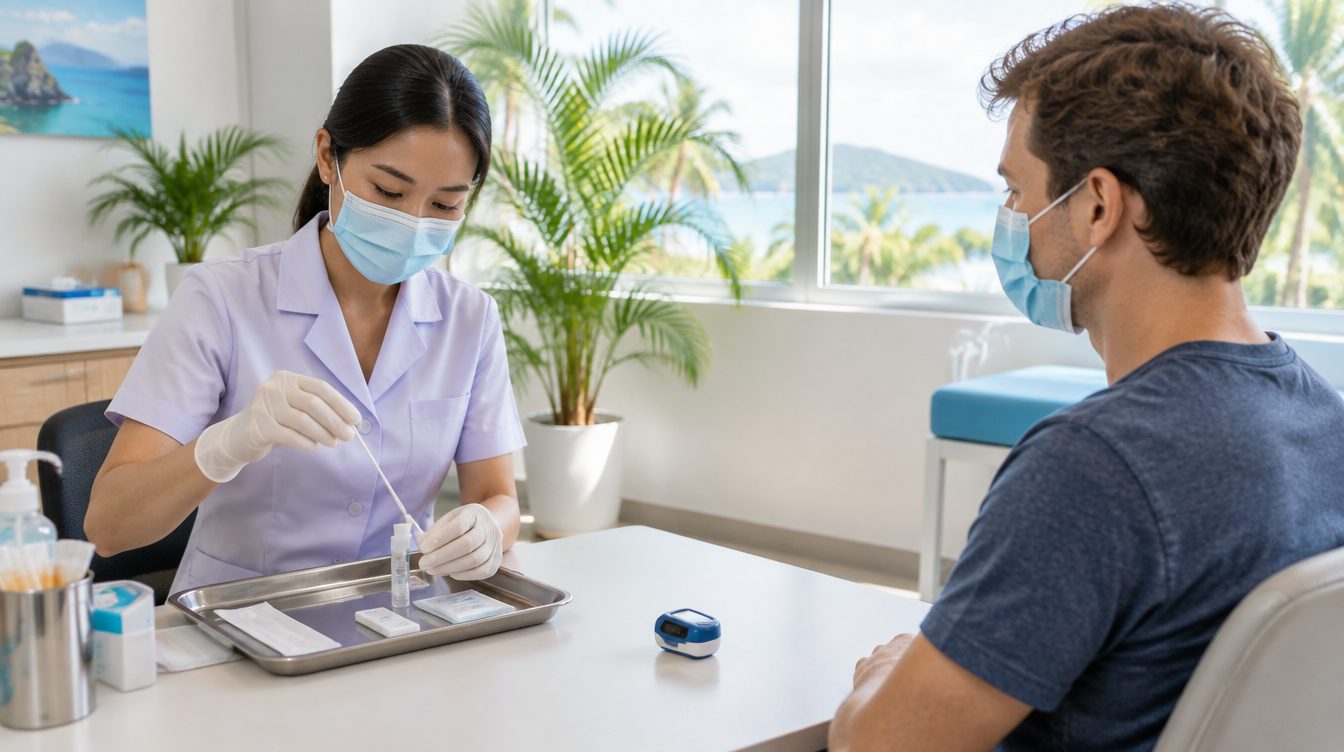
Antigen test kits, known locally as ATKs, are sold in Thai pharmacies and are fine for a first check. An early negative can turn positive a day or two later, so repeat after 48 hours if you still feel unwell. A clinic antigen test adds documentation, with your name, date and result on a medical record, which is what insurers usually want. PCR detects smaller amounts of virus and can be arranged when the diagnosis is uncertain, and we often swab for influenza at the same visit.
Antivirals for higher-risk adults
The main outpatient antiviral is nirmatrelvir with ritonavir, taken as tablets twice a day for five days. Nirmatrelvir blocks an enzyme the virus needs to copy itself, and ritonavir slows its breakdown so that levels stay effective. It must start within 5 days of the first symptom and is intended for adults at higher risk of severe disease, where it lowers the chance of hospital admission; healthy, vaccinated younger adults gain little.
Ritonavir interacts with many common medicines, including some statins, blood thinners, heart rhythm drugs, sedatives and erectile dysfunction tablets. Some can be paused for a few days, while others rule the antiviral out. Bring your medicines or photos of the packets, and mention kidney disease, because the dose is lowered when kidney function is reduced. Molnupiravir is a less effective alternative for some people and is not used in pregnancy. Ask us on WhatsApp whether an antiviral is in stock today.
| Your situation | What we usually suggest |
|---|---|
| Under 65, vaccinated, mild symptoms | Rest, fluids, paracetamol, throat and cough relief |
| 65 or over, or a chronic heart, lung, kidney or immune condition, within 5 days | Assessment and a medicine check for nirmatrelvir with ritonavir |
| Pregnant | Same-day assessment, with treatment weighed for mother and baby |
| More than 5 days of mild symptoms | Symptom care, watching for breathlessness |
| Breathless, or oxygen reading of 94% or lower | Urgent assessment, hospital care if it keeps falling |
| Symptoms beyond 12 weeks | Planned long COVID review and referral |
Caring for yourself, and for everyone else
Rest, drink regularly and use paracetamol for fever and aches; as with any fever in Phuket, avoid ibuprofen and aspirin until dengue has been considered. If you have a pulse oximeter, check it twice a day at rest with warm hands. At the time of writing Thailand does not require tourists with COVID-19 to quarantine, but the considerate approach is to stay in your room while feverish, then mask indoors for a few days and skip crowded boats, bars and minivans.
Tours, flights and proof for your insurer
A feverish passenger on a speedboat has few options if they get worse at sea. If a positive test forces you to cancel a tour, change a flight or extend a hotel stay, most insurers want evidence from a medical practitioner, not a photo of a home kit, and a clinic visit gives you a documented diagnosis and medical report. Once you have recovered, a fit-to-fly certificate can be issued after an examination if your airline or insurer asks for one.
When to see a doctor
See a doctor on the first or second day if you are in a higher-risk group, because the antiviral window closes at day 5. For anyone, the concerning signs are breathlessness, chest pain, confusion or fainting, a fever lasting beyond five days, or a cough that worsens in the second week. Oxygen can fall before you feel very breathless, especially in older adults, so a falling oximeter reading matters even if you feel fine.
Prevention and early detection
Updated COVID-19 vaccines lower the risk of severe illness, and boosters matter most for adults over 65 and people with weakened immunity or chronic disease. Ask us on WhatsApp whether a vaccine is in stock today if you are due one while here. Open-air seating and a mask on flights help higher-risk travellers. Early detection is what makes treatment possible, so higher-risk travellers should pack antigen kits, a thermometer and a medicine list, and test at the first sore throat or fever.
Seeing a doctor for COVID-19 at Takecare Clinic
You can walk in at any hour, without booking, at the Bangtao (Cherngtalay) clinic, our Kata-Karon clinic or the Patong clinic. Because COVID-19 is infectious, a message on WhatsApp before you arrive helps us seat you away from other patients, or phone +66 81 718 9080. A doctor hotel visit in Phuket brings the swab, examination and prescription to your room, 24/7. We confirm the price on WhatsApp beforehand, bill most travel insurers directly and prepare medical reports and itemised invoices for claims or trip changes.
Related treatments and services
If your swab is negative but the aches are fierce, read about flu treatment; for a fever with no clear cause, see fever treatment. A throat that stays painful is covered under sore throat treatment, swollen tonsils with pus under tonsillitis treatment, and a cough lasting weeks under bronchitis treatment. If your wheeze flares, see asthma treatment in Phuket. Ear pain after flying congested needs ear infection treatment, and a streaming nose without fever may be an allergy rather than a virus. See also our walk-in doctor in Phuket service and all the conditions we treat.
Summary
COVID-19 is now usually short and mild, but it can still be serious for older and vulnerable people, who need a documented test and a decision about nirmatrelvir with ritonavir within 5 days. For everyone else, the priorities are rest, paracetamol, consideration for other travellers, and a medical report if plans change.
“Test early if you develop symptoms, and let us know within five days if you are over 65 or have a long-term condition. That is the window when antivirals help most.”
Dr. Ponlawat Pitsuwan, Physician, Takecare Clinic Phuket
Frequently asked questions
I tested positive on a pharmacy kit. Do I still need a doctor?
Not always. If you are young, vaccinated and mildly unwell, rest at the hotel is usually enough. See a doctor if you are 65 or over, pregnant or have a long-term condition, because antivirals must start within 5 days, if you need documented proof for insurance, or if you become breathless.
Will my insurer accept the clinic’s paperwork if COVID-19 disrupts my trip?
Policies differ, and some limit COVID-19 claims, so check your wording. Insurers generally want a diagnosis from a medical practitioner, which we provide as a medical report with the test result, plus receipts and an itemised invoice. We also bill most travel insurers directly, and confirm the price on WhatsApp before you come.
How soon do I need to start an antiviral?
Nirmatrelvir with ritonavir must begin within 5 days of your first symptom, and earlier is better. If you are higher risk, that means seeing a doctor on the day you test positive. The doctor needs time to review your other medicines and kidney function, so arriving on day four leaves little room.
Do I need an appointment for a COVID-19 test?
No appointment is needed at any of our three clinics, which are open around the clock. Walk-in patients are usually seen within minutes and the antigen result is ready during the visit. A WhatsApp message before you arrive helps us keep you separate from other patients.
Can you test and treat me in my hotel so I do not expose other guests?
Yes. A doctor can come to your hotel room, villa or condo anywhere in Phuket, day or night. The visit covers the swab, checks of your temperature, oxygen level and chest, and a prescription if needed. For infectious guests it is often kinder than a taxi and a waiting room.
Can I fly home while I still test positive?
Most airlines no longer ask for a negative test, but you should not travel with a fever or while acutely unwell, and wearing a mask on board is considerate. Antigen tests can stay positive for several days after you feel better. If your airline or insurer wants a statement that you are fit to travel, we can examine you and provide one.
Sources
The NHS describes symptoms and who can get treatment on its COVID-19 overview. The World Health Organization summarises the disease, risk groups and vaccination in its COVID-19 fact sheet. The CDC explains antiviral options on its COVID-19 treatment page.
COVID-19, coronavirus, SARS-CoV-2, long COVID, nirmatrelvir, ritonavir, molnupiravir, antigen test kit, ATK, RT-PCR, pulse oximetry, oxygen saturation, fit-to-fly certificate, COVID-19 vaccine, WHO, CDC, NHS, Bangtao, Cherngtalay, Kata, Karon, Patong, Takecare Clinic Phuket, Dr. Ponlawat Pitsuwan
This page is general health information and not a substitute for a medical consultation.