Medically reviewed by Dr. Ponlawat Pitsuwan, Physician, Takecare Clinic Phuket. Last reviewed: September 2026.
I see fit to fly requests most often from pregnant travellers, people recovering from an illness or injury on holiday, and divers who want to check their timing. Airline rules differ, so I always ask to see the specific requirements before writing anything.
Fit-to-fly requests in Phuket usually come in the last days of a trip, when something has changed since the outbound flight. A pregnancy has passed the point where the airline wants paperwork, a week of diving has ended with a blocked ear or a cough, or a scooter fall has left a cast or a row of stitches. Now and then a check-in agent notices a rash or a heavy cough and asks for clearance before boarding. We assess you promptly and give an honest opinion, because a letter only helps if flying really is safe for you.
When airlines ask for medical clearance
There is no single international rule. Each airline publishes its own conditions, and many use a medical information form, often called a MEDIF, which a doctor completes and the airline’s medical team reviews. As a rough guide, expect to need a letter once you are past about 28 weeks of pregnancy, and after an operation or a serious illness in the recent past. Rules differ between carriers and occasionally between routes, so look up your own airline’s policy or phone them before seeing us, and bring any form they send.
| Situation | What the letter usually confirms | Worth knowing |
|---|---|---|
| Pregnancy from about 28 weeks | Due date, one baby or more, no complications | Many airlines stop carrying passengers late in pregnancy, commonly around 36 weeks for one baby and earlier for twins |
| Recent surgery | Operation and date, healing, no complications | Safe waiting times depend on the operation, and your surgeon’s advice comes first |
| Serious illness or hospital stay | Diagnosis, recovery, oxygen level, no longer infectious | A hospital discharge summary helps a great deal |
| Fracture or plaster cast | Injury, type of cast, circulation in the limb | Some airlines ask for a newly applied full cast to be split, because limbs swell at altitude |
| Chickenpox or similar infection | That you are no longer infectious | Usually not accepted until every spot has crusted over |
| Lung or heart condition | Stability, oxygen saturation, any need for in-flight oxygen | Airlines need advance notice to arrange oxygen |
What happens at the assessment
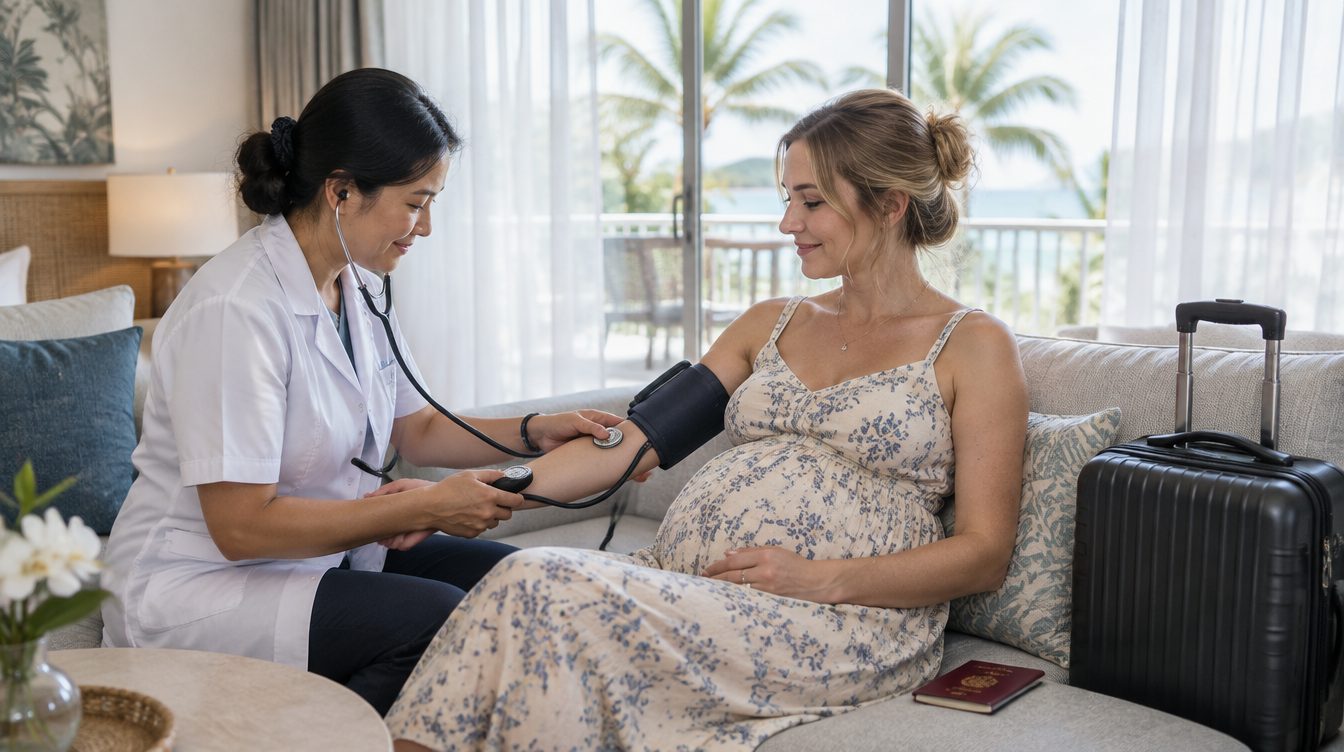
The doctor starts with why you or the airline are concerned, then reviews any hospital paperwork, scan reports or antenatal notes. A nurse measures blood pressure, pulse, temperature and oxygen saturation, the share of oxygen carried in your blood, read with a clip on your finger. Cabin air is pressurised to the equivalent of roughly 1,800 to 2,400 metres above sea level, so blood oxygen dips a little on every flight. Healthy people do not notice, but people with lung or heart disease may. Depending on the reason, the doctor listens to your chest, checks a wound or cast, or in pregnancy asks about pain, bleeding and the baby’s movements.
If all is well, the letter records the findings, states that you are fit to fly on a given date, and notes any conditions such as an aisle seat or wheelchair help at the airport. If flying is not safe yet, we tell you plainly and explain what needs to change first.
Diving, then flying home
Phuket is a base for dive trips to the Similan Islands, Racha Yai and Phi Phi, and the gap between your last dive and your flight matters. Diving medicine guidance advises a minimum of 12 hours on land after one no-decompression dive, 18 hours or more after several dives in a day or consecutive dive days, and longer still if any dive needed decompression stops. Joint pain, numbness, unusual tiredness, a blotchy rash or breathlessness after diving can signal decompression illness. Do not fly, and get urgent help, because treatment may need a recompression chamber.
Long-haul flights and blood clots
Flights home from Phuket to Europe, Australia or the Middle East often last many hours. Sitting still for a long time slightly raises the risk of deep vein thrombosis, a clot in a leg vein, and the risk is higher after recent surgery or a leg injury, in pregnancy, and with previous clots or oestrogen-containing medicines. Walk the aisle when it is safe, flex your ankles regularly, drink water and go easy on alcohol. People at higher risk may benefit from properly fitted compression stockings, and the doctor will advise whether anything more is needed.
When to see a doctor
See a doctor before you fly if you have a fever, a cough with breathlessness, chest pain on exertion, new pain or swelling in one calf, bleeding or regular tightenings in pregnancy, severe ear or sinus pain, or any new symptom after diving. Do not wait for a clinic appointment: call 1669, Thailand’s emergency medical service, or go to a hospital emergency department, for chest pain, sudden breathlessness, coughing up blood, fainting, heavy vaginal bleeding or signs of a stroke.
Prevention and early detection
Most fit-to-fly problems are avoidable with a little planning. Check your airline’s rules on pregnancy and medical conditions when you book, not at the airport, and carry your antenatal notes or discharge summary. Pack regular medicines in your hand luggage, with enough to cover delays. If you have a cold, a decongestant nasal spray before descent can ease ear pain. After an operation or injury, book an assessment two or three days before departure rather than on the morning of the flight, so there is time to arrange a wheelchair or oxygen.
Arranging your fit-to-fly check with us
Takecare Clinic Phuket is open 24 hours a day at the Bangtao (Cherngtalay) clinic, the Kata-Karon clinic and the Patong clinic. A walk-in doctor in Phuket can usually see you within minutes, or you can send us your airline form on WhatsApp first so we can prepare. Prefer to stay put? A doctor hotel visit in Phuket is available at any hour, which suits late pregnancy or a painful injury. Bring your passport, flight details, the airline’s form and any medical records. To talk it through, call +66 81 718 9080. Where your policy covers the assessment, we bill most travel insurers directly; otherwise you receive itemised receipts and a medical report to claim yourself.
Related services and treatments
If a doctor advises you not to fly yet, your insurer and airline will usually want written proof, and a medical certificate in Phuket covers the dates you were unfit to travel. Injured on the road? Our motorbike accident care page explains wound and fracture checks before a flight. For vaccines and pre-trip advice before your next destination, see travel medicine in Phuket. If a delay leaves you short of tablets, arrange a prescription refill in Phuket, or browse all our medical services.
Summary
A fit-to-fly certificate is a doctor’s signed opinion that you can travel safely by air, based on an examination close to your departure date. The need for one is set carrier by carrier, and it arises most in the third trimester and in the weeks after an operation, a hospital stay or a fracture. See us two or three days before you fly, bring your records and the airline’s form, and check your airline’s current policy so the letter says exactly what they need.
“Check your airline’s medical rules before your appointment and bring them with you. Some airlines need a specific form, and having it saves a second visit.”
Dr. Ponlawat Pitsuwan, Physician, Takecare Clinic Phuket
Frequently asked questions
How close to my flight should the letter be dated?
Airlines set this themselves, and many want the letter dated within a few days of departure. We usually suggest an assessment two or three days before you fly, which leaves time for any follow-up or extra paperwork. Check your airline’s exact wording, because a letter that is older than they allow may be refused at check-in.
I am 30 weeks pregnant. Can you write my letter?
Yes, if your pregnancy has been straightforward. Bring your antenatal notes showing the due date and scan results, and tell us your airline and flight dates. The doctor checks your blood pressure and asks about pain, bleeding and the baby’s movements. Airline cut-off dates differ, especially for twins, so confirm your airline’s policy before the visit.
Can I walk in for a fit-to-fly check without booking?
Yes. All three clinics accept walk-ins 24/7 and most visits take under 30 minutes. If your airline has sent a MEDIF or its own medical form, send it to us on WhatsApp beforehand so the doctor can see what is needed, and we confirm the price before your visit.
Can the doctor do the assessment at my hotel or villa?
Yes. A doctor can come to your hotel, villa or condo anywhere in Phuket, day or night, and issue the letter during the visit. This is often easier in late pregnancy, with a cast or crutches, or when you are still recovering from an illness and would rather rest before a long journey.
Will my travel insurance pay for the fit-to-fly assessment?
It depends on your policy and the reason for the check. If it follows an illness or injury your insurer is already covering, the visit is often included, and we offer direct billing with most travel insurers. A routine pregnancy letter is usually a personal cost. We confirm the price on WhatsApp and give you itemised receipts.
What happens if the doctor decides I should not fly yet?
We explain why, what needs to improve and roughly when it is worth reassessing. We can give you a certificate stating that you are unfit to travel, which airlines and insurers usually need before changing a ticket or paying a claim. If you need a specialist opinion or hospital care, we arrange a referral.
Sources
The NHS explains airline rules and precautions for travelling in pregnancy, and its page on deep vein thrombosis covers clot risk and warning signs. Airline medical departments base their clearance decisions on the IATA Medical Manual.
fit to fly certificate, fit-to-fly letter, airline medical clearance, MEDIF, medical information form, air travel in pregnancy, deep vein thrombosis, DVT, compression stockings, oxygen saturation, pulse oximetry, cabin pressure, decompression illness, chickenpox, IATA, 1669, Bangtao, Kata, Karon, Patong, Takecare Clinic Phuket, Dr. Ponlawat Pitsuwan
This page is general health information and not a substitute for a medical consultation.