Medically reviewed by Dr. Ponlawat Pitsuwan, Physician, Takecare Clinic Phuket. Last reviewed: September 2026.
PEP is one of the few treatments where every hour counts, and I see people who waited a day or two out of embarrassment. I would much rather see someone within hours, and I treat these visits with complete discretion and without judgement.
Requests for PEP rarely arrive at a convenient hour. More often it is the early morning after a night out, a condom that split, a partner whose HIV status was unknown, or an encounter that was not fully consensual. What these situations share is a clock: the medicines work best in the first hours and are not recommended after 72. We would far rather see you early for a situation that turns out to be low risk than late for one that was not, so if you are unsure, come in and let us weigh it up with you.
Why the first hours matter
When HIV enters the body, it does not become a permanent infection straight away. For a short period it replicates in cells near the point of entry and in nearby lymph nodes before spreading. Antiretroviral medicines given during that period can stop the infection from taking hold. The earlier the first dose, the better the odds, so guidelines aim for the first 2 hours and draw a firm line at 72. PEP greatly reduces the risk of HIV, but it is not 100% effective, and it does nothing for exposures that happened before the 72-hour window.
Does your exposure need PEP?
The decision depends on the type of contact and what is known about the other person. The doctor will ask about both, and you can answer as fully or briefly as you are comfortable with.
| Situation | Usual advice |
|---|---|
| Condomless anal sex, or a condom failure, with a partner of unknown status or living with HIV and not on effective treatment | PEP recommended |
| Condomless vaginal or frontal sex with a partner of unknown status | Often recommended; the doctor weighs the partner’s likely risk |
| Sexual assault | PEP usually recommended, alongside hospital care |
| Sharing needles or injecting equipment | PEP recommended |
| Oral sex, giving or receiving | Rarely needed, as the risk is very low |
| Partner living with HIV with an undetectable viral load for at least 6 months | Not needed, because HIV is not transmitted sexually (U=U) |
| Needle-stick from a discarded needle on a beach or street | HIV risk very low; hepatitis B vaccination and tetanus matter more |
| Exposure more than 72 hours ago | PEP not recommended; plan HIV testing instead |
What happens when you come in for PEP
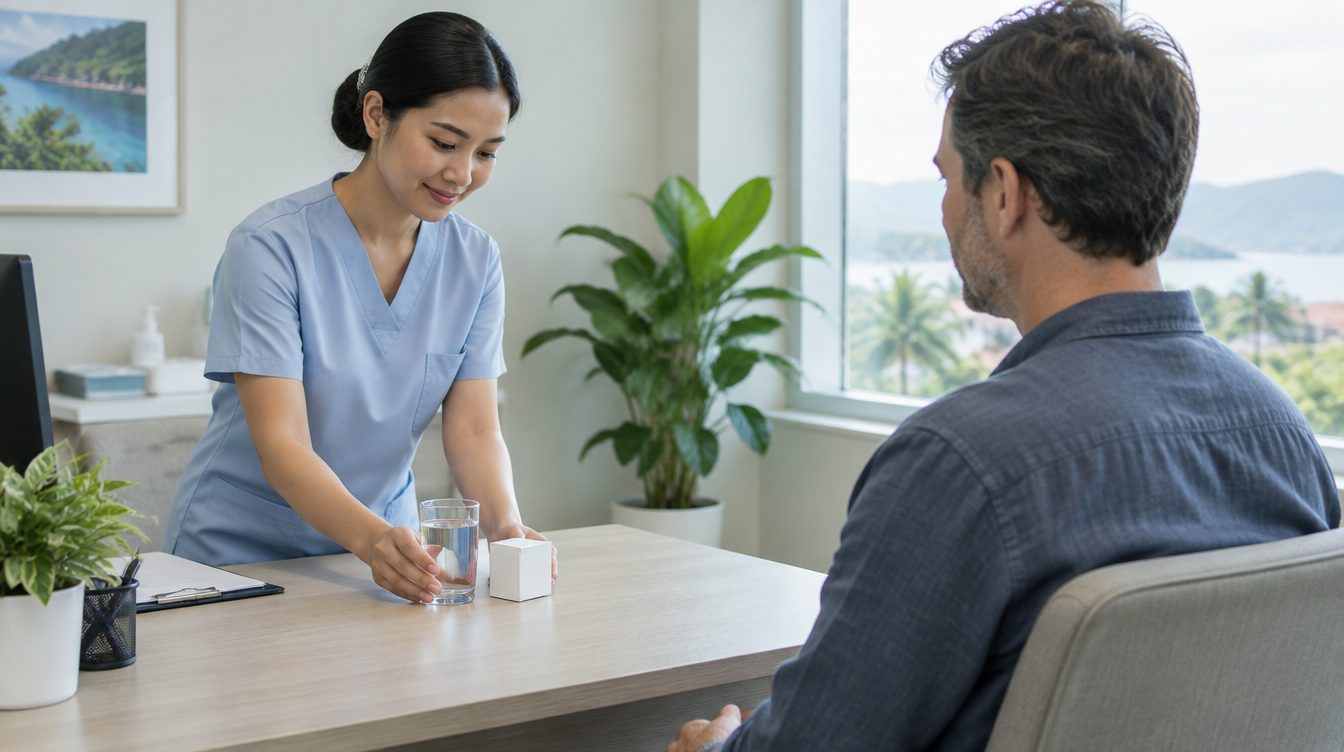
Tell reception you need PEP; you do not need to say more at the desk, and you will be seen quickly. The doctor confirms the timing and type of exposure, then takes baseline blood tests: an HIV test to establish your status before the exposure, hepatitis B and hepatitis C, and kidney function, because some PEP medicines are cleared by the kidneys. A syphilis and STI screen and, where relevant, a pregnancy test are usually added. The first dose is started without waiting for most of these results, because every hour counts.
PEP is a combination of three antiretroviral drugs taken every day for 28 days. A widely used regimen pairs tenofovir with emtricitabine or lamivudine, plus dolutegravir, an integrase inhibitor; the exact choice depends on your kidney function, other medicines and pregnancy. If there was a risk of pregnancy, we can discuss emergency contraception at the same visit: levonorgestrel works best as early as possible within 72 hours, and ulipristal can be used up to 120 hours. If you are not immune to hepatitis B, vaccination is started, sometimes with immunoglobulin.
Getting through the 28 days
Modern PEP regimens are much better tolerated than older ones. Some people notice nausea, tiredness, headache or loose stools in the first week, and these usually settle. Taking the tablets with food and at the same time each day helps. If you miss a dose, take it as soon as you remember unless the next one is nearly due, and do not double up. Completing the full course matters: stopping early leaves you less protected. Alcohol does not interact directly with the medicines, but late nights and hangovers are the most common reason doses are forgotten, so set an alarm.
Many visitors fly home before day 28. That is fine, as long as you have enough medicine for the whole course and a letter summarising the regimen and your baseline results for your home clinic. Keep the tablets in hand luggage in their original packaging, and adjust dose times gradually to the new time zone.
Follow-up testing after PEP
A negative baseline HIV test only shows your status before the exposure. Follow-up HIV testing is needed after the course, usually around six weeks after the exposure and again at about twelve weeks, and we give you a written schedule. Testing for syphilis, hepatitis B and hepatitis C may be repeated too, and a chlamydia and gonorrhoea check is worthwhile from two weeks after the exposure. Our HIV test in Phuket page explains the tests used, and STD testing in Phuket covers the wider panel. Use condoms until your follow-up results are clear, to protect partners.
When to see a doctor
Any possible HIV exposure within 72 hours is a reason to come in now rather than in the morning. While on PEP, seek care promptly for a rash with fever, yellowing of the skin or eyes, severe abdominal pain or persistent vomiting that stops you keeping tablets down. A flu-like illness with fever, sore throat and rash in the weeks after exposure should also be checked with an HIV test.
Prevention and early detection
PEP is an emergency measure, not a routine method. If you find yourself needing it more than once, PrEP taken before exposure is far more reliable, and we can move you from PEP straight onto PrEP at the end of the course with no gap; our PrEP clinic in Phuket page explains how. Condoms remain the main protection against other STIs. If a partner is living with HIV and on treatment, knowing their viral load is undetectable is itself strong protection. Knowing the 72-hour rule before a trip means you will not lose precious hours wondering what to do.
Where to start PEP tonight
PEP cannot wait for office hours, and none of our clinics close. Walk straight in to the Bangtao (Cherngtalay) clinic, the Kata-Karon clinic or the Patong clinic, whichever you can reach fastest. For urgent questions, WhatsApp our team or call +66 81 718 9080. Our walk-in doctor in Phuket service usually sees people within minutes, and an emergency doctor in Phuket is available at every hour for anything more serious.
If you cannot travel, a doctor hotel visit in Phuket can be arranged 24/7, and you can ask on WhatsApp whether PEP can be started during the visit. We confirm the price on WhatsApp before your visit. Some travel and health plans treat PEP as urgent care; for a claim, we hand you an itemised invoice, a receipt and a doctor’s report.
Related services and treatments
PEP protects against HIV only. If the same exposure leads to symptoms, you may need chlamydia treatment for discharge or burning, or herpes treatment for genital sores. A cold sore on a partner’s lip carries no HIV risk but can pass HSV-1 through oral sex, as our cold sore treatment page describes. For women, a change in discharge in the weeks afterwards is often bacterial vaginosis rather than an STI, covered under BV treatment. Browse all our medical services for other care during your stay.
Summary
PEP is four weeks of a three-drug HIV regimen, most effective in the first couple of hours and not advised once 72 hours have passed. Come in at any hour, tell reception you need PEP, and the first dose can usually be taken at the same visit while baseline tests run. Finish the full course, keep a written plan for follow-up HIV tests at about six and twelve weeks, and consider PrEP if the risk is likely to recur.
“Do not wait until morning or until you feel ready to talk about it. Come in as soon as you can, ideally within two hours, and certainly within 72.”
Dr. Ponlawat Pitsuwan, Physician, Takecare Clinic Phuket
Frequently asked questions
It has been 60 hours. Is it too late to start PEP?
No, 60 hours is still within the 72-hour limit, but the effectiveness of PEP falls with every hour, so come in now rather than later today. Tell reception you need PEP and you will be seen quickly. After 72 hours, PEP is not recommended, and the focus moves to a clear testing plan instead.
How fast can I get the first dose?
Usually within the same short visit. After a brief assessment and a baseline HIV test, the first dose can normally be taken before you leave, without waiting for the other blood results. If you want to confirm anything before travelling to us, send a WhatsApp message and we will reply straight away.
Do I need to book, or can I come at 4 am?
You never need to book for PEP. All three clinics are open 24 hours, including 4 am, and PEP is treated as urgent. Walk in to whichever clinic is closest, and if you are unsure whether your situation needs PEP, come anyway; it is much better to be assessed early than to lose hours deciding.
Can a doctor start PEP in my hotel room?
Yes, one of our doctors can come to your room, day or night, to go through the risk assessment and draw the baseline bloods there. Message us on WhatsApp so we can confirm whether PEP can be started during the visit; if travel to a clinic is quicker, we will tell you, because speed matters most.
Will my insurance pay for PEP?
Coverage varies. Some travel and international health plans pay for PEP as urgent care, while others exclude it. Our team tells you the cost on WhatsApp before you come, and the paperwork you need for a claim is handed over at the end of the visit. Please do not delay PEP while waiting for insurance approval, because the time window is short.
Do I need PEP if the condom broke with a partner who says they are HIV-negative?
It depends on how recent and reliable that negative result is. A test taken before their own most recent risks may not reflect their status now. If their result is recent and they have had no risks since, PEP may not be needed. If there is real uncertainty, come in and we will weigh the details with you.
Sources
The NHS explains when PEP is used in its guide to HIV prevention, including PEP. The CDC summarises who should consider PEP on its PEP guidance page. The World Health Organization HIV fact sheet covers prevention worldwide.
PEP, post-exposure prophylaxis, emergency HIV prevention, antiretroviral therapy, tenofovir, emtricitabine, lamivudine, dolutegravir, integrase inhibitor, baseline HIV test, fourth-generation HIV test, hepatitis B vaccination, emergency contraception, levonorgestrel, ulipristal, U=U, PrEP, 1669, NHS, CDC, WHO, Bangtao, Cherngtalay, Kata, Karon, Patong, Phuket, Takecare Clinic Phuket, Dr. Ponlawat Pitsuwan
This page is general health information and not a substitute for a medical consultation.