Medically reviewed by Dr. Ponlawat Pitsuwan, Physician, Takecare Clinic Phuket. Last reviewed: September 2026.
Many of the blood tests I order in Phuket are to answer one practical question quickly, for example whether a fever could be dengue or whether dehydration has affected the kidneys. Having a laboratory on site means we can often act on results the same day rather than guessing.
A large share of the blood samples we draw in Phuket belong to visitors who felt fine on arrival and then woke up feverish after a few days of heat, sun and mosquitoes. The rest come in on purpose: long-stay guests who are overdue for a cholesterol check back home, people on regular tablets who need a kidney or liver reading before a refill, and travellers who would rather do their sexual health screening quietly while away. Whatever brings you in, the real question is usually how quickly you can have an answer. For the common tests, that answer arrives the same day, and a doctor sits down with you to put the numbers in context.
Who books a blood test with us
We see three broad groups. The first is people who are unwell right now, most often with fever, and who need a fever treatment plan based on evidence rather than guesswork. Here a full blood count and a dengue screen can change the plan within an hour or two. The second group wants a planned check: an annual review of blood sugar, cholesterol and kidney function, or a wider health check-up in Phuket built around a physical examination. The third group needs a specific result for a specific reason, such as a thyroid level for a medicine dose, a uric acid level after a painful toe, or screening after a new partner.
You do not need a referral letter. Ordering every test on the menu tends to produce borderline results that cause worry without changing anything, so tell us what you want to find out.
From first question to printed report
The visit starts with a short consultation. The doctor asks about symptoms, medicines, supplements, alcohol, recent travel and what you hope to learn, then selects the tests that answer that question. If a test needs fasting and you have just eaten, we tell you so and you can come back the next morning.
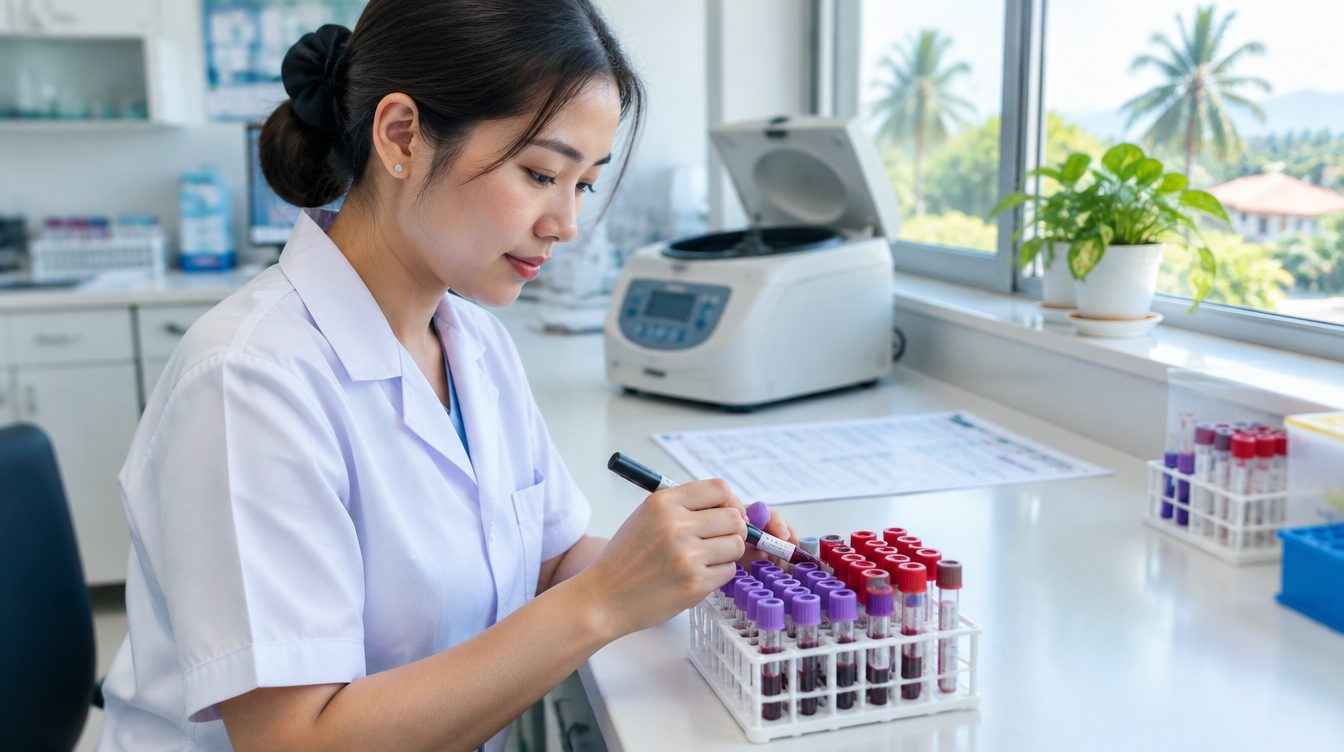
The draw itself takes a few minutes: blood from a vein in the inside of the elbow goes into labelled tubes, and you feel a brief sting. If you tend to faint, say so and you can lie down. The tubes go to our on-site laboratory, and when the results are ready the doctor reviews them with you, explains whether anything outside the range matters, and suggests the next step, which may be nothing at all. You leave with a copy of the report for your own doctor at home.
The tests we are asked for most
The table below covers the everyday requests. Preparation advice is general; the doctor confirms what applies to you when the tests are chosen.
| Test | What it measures | Common reason in Phuket | Preparation |
|---|---|---|---|
| Full blood count (CBC) | Red cells, white cells, platelets, haematocrit | Fever, suspected infection, dengue monitoring, tiredness | None |
| Fasting glucose and HbA1c | Blood sugar now, and the average over about 3 months | Diabetes screening or review, unusual thirst | 8 hours without food for fasting glucose; none for HbA1c |
| Lipid profile | Total cholesterol, LDL, HDL, triglycerides | Heart and stroke risk review | Fasting often requested; ask us |
| Kidney function | Creatinine, eGFR, sodium, potassium | Dehydration, blood pressure tablets, diuretics | Drink water normally |
| Liver function | ALT, AST, GGT, bilirubin | Alcohol, hepatitis, long-term medicines | Tell us about recent drinking |
| Uric acid | Urate level in the blood | Joint pain, gout follow-up | None |
| Thyroid (TSH, free T4) | Thyroid hormone control | Fatigue, weight change, palpitations, dose checks | Mention any biotin supplement |
| Dengue NS1, IgM, IgG | Virus protein and antibodies | Fever with body aches | Timing matters; see the dengue page |
| HIV, syphilis, hepatitis B | Infection markers | Sexual health screening | Window periods apply |
For fever, the timing of the dengue sample matters: a virus protein called NS1 is easiest to detect in the first five days, while antibodies appear later. Our page on the dengue test in Phuket explains which combination suits which day of illness. For sexual health, each infection has a window period before a test becomes reliable, which is covered in detail on the STD testing in Phuket page.
Preparing well so the numbers are trustworthy
Fasting means no food and no drinks other than plain water for about 8 hours before a fasting glucose, and often 9 to 12 hours when a full lipid profile is part of the request. Because we are open around the clock, many people come in at breakfast time before eating. Keep taking your usual medicines unless the doctor tells you otherwise, and bring the packets or a photo of the labels.
Phuket’s climate affects results more than visitors expect. A day of sweating on the beach with little water can nudge creatinine up and concentrate the blood, so drink normally the day before a kidney test. Heavy drinking in the previous days can raise liver enzymes and triglycerides, and high-dose biotin, sold for hair and nails, can distort thyroid and some hormone results.
Reading a result that sits just outside the range
Reference ranges are built so that about one healthy person in twenty falls slightly outside them on any single test, so one borderline value is a prompt to look at the whole picture, not a diagnosis. A mildly low white cell count during a viral illness usually recovers; a mildly high ALT after a week of cocktails often settles once the drinking stops. What matters more is a clear abnormality, several results pointing the same way, or a change from earlier reports, so bring old results, even as photos on your phone. Where action is needed, the options are a repeat test, treatment here, follow-up at home or a hospital specialist referral while you are still on the island.
When to see a doctor
A blood test is often the second step, not the first. Some symptoms should bring you to a doctor straight away, whether or not you had planned a test. A fever above 38°C with severe headache, pain behind the eyes or a rash needs same-day assessment in Phuket because dengue is common. Bleeding gums, nosebleeds, black stools or unexplained bruising need a blood count urgently. Extreme thirst with passing large amounts of urine and drowsiness can mean very high blood sugar.
Prevention and early detection
Blood tests earn their keep when they catch a silent problem early. Guideline programmes give a sensible rhythm. The NHS Health Check offers adults aged 40 to 74 a cholesterol and cardiovascular risk review every 5 years. The US Preventive Services Task Force advises screening for prediabetes and type 2 diabetes in adults aged 35 to 70 who are overweight. The CDC recommends everyone aged 13 to 64 has at least one HIV test, with more frequent testing for anyone with new or multiple partners. Individual risk changes these intervals: a strong family history of heart disease, a previous abnormal result or certain medicines justify testing more often.
Having your blood taken at Takecare Clinic
All three clinics are open 24 hours a day, every day, with English-speaking doctors and an on-site laboratory. You can walk in to our Bangtao (Cherngtalay) clinic, the Kata-Karon clinic or the Patong clinic, and most people are seen within minutes. If you prefer to check fasting rules or ask which tests suit you first, message us on WhatsApp; we confirm the price on WhatsApp before your visit. You can also phone +66 81 718 9080.
If you are too unwell to travel, or staying at a villa far from town, a doctor hotel visit in Phuket lets the sample be taken in your room and brought back to the lab. For insurance, we provide receipts, a medical report and an itemised invoice, and we offer direct billing with most travel insurers. Tests ordered to investigate symptoms are more often covered than routine screening, so check your policy wording.
Related services and treatments
Blood tests sit alongside the rest of our primary care. If you simply want to be seen quickly for a new symptom, our walk-in doctor in Phuket service is the usual starting point, and the doctor will order bloods only if they add something. The full range of consultations, procedures and tests is listed on all our medical services.
Summary
A blood test in Phuket is quick to arrange: walk in to any of our three clinics at any hour, see a doctor who picks the tests that answer your question, and get common results the same day. Prepare sensibly by fasting when asked, drinking normally in the heat and mentioning supplements. Treat a borderline figure as information rather than a verdict, and keep a copy of every report for your own doctor. If you feel acutely unwell, get assessed first; the test follows the consultation, not the other way round.
“Ask us whether you need to fast before your test. For most everyday blood tests you do not, and you can have them done on the same visit.”
Dr. Ponlawat Pitsuwan, Physician, Takecare Clinic Phuket
Frequently asked questions
How much will my blood test cost, and can I claim it on travel insurance?
The price depends on which tests the doctor selects, so we confirm it on WhatsApp before your visit rather than quoting a flat fee. Travel insurance usually covers tests ordered to investigate new symptoms such as fever, while routine screening is often excluded. We provide an itemised invoice, receipts and a medical report for your claim, and offer direct billing with most travel insurers.
How long until I get my results back?
Common tests, including a full blood count, blood sugar, cholesterol, kidney and liver function and rapid dengue screening, usually come back the same day from our on-site laboratory, often within a few hours. Some specialised tests take longer. The doctor tells you the expected turnaround before the sample is taken, and goes through every result with you once it is ready.
Can I just turn up, or do I need an appointment for a blood draw?
You can simply walk in to any of our three clinics at any time of day or night, and most people are seen within minutes. For fasting tests, the easiest plan is to come in the morning before breakfast. Sending a WhatsApp message first is useful if you want to check preparation, confirm the price or ask whether a particular test is available.
Can a doctor take my blood sample at my hotel or villa?
Yes. Our doctors make hotel and villa visits anywhere in Phuket around the clock. The doctor assesses you, takes the sample in your room and brings it back to our laboratory for processing. This is especially helpful if you have a high fever, feel dizzy in the heat or are looking after young children and cannot easily travel to a clinic.
Do I really need to fast, and can I drink water?
Only some tests need fasting. A fasting glucose needs about 8 hours without food, and a lipid profile often 9 to 12 hours. Plain water is fine and actually helps, because being well hydrated makes veins easier to find in the heat. Coffee, juice and alcohol count as food for this purpose. Keep taking regular medicines unless the doctor advises otherwise.
Can dengue and sexual health screening be done in the same visit?
Yes, a single blood draw can cover several panels, so a dengue screen, a full blood count and tests for HIV, syphilis and hepatitis B can be taken together. The catch is timing: dengue tests depend on the day of fever, and each sexual infection has its own window period. The doctor checks both timelines so you do not test too early.
Sources
The NHS overview of blood tests describes what happens during a blood draw and how to prepare. MedlinePlus explains the complete blood count and what each component means. The CDC sets out who should be offered HIV testing and how often.
blood test, blood draw, venepuncture, full blood count, complete blood count, CBC, HbA1c, fasting glucose, lipid profile, cholesterol, LDL, HDL, triglycerides, kidney function, creatinine, eGFR, liver function test, ALT, AST, GGT, uric acid, TSH, thyroid function, CRP, dengue NS1, IgM, IgG, HIV test, syphilis, hepatitis B, NHS Health Check, USPSTF, CDC, MedlinePlus, Bangtao, Cherngtalay, Kata, Karon, Patong, Takecare Clinic Phuket, Dr. Ponlawat Pitsuwan
This page is general health information and not a substitute for a medical consultation.